FUJI NAGOYA SCIENCE MUSEUM
TOP > Exhibition Guide > Keyword Search > Starting with "I" > Imperial carriage > Follow Carriage No.344
Follow Carriage No.344


Purpose of Exhibition
In order to nurture children's dreams and further promote science education, the Railway Plaza exhibits a carriage that was once attached to the Imperial train, and we hope that visitors will gain a deeper understanding of the railway culture of the past.
Additional Knowledge
[What is an Follow Carriage?]
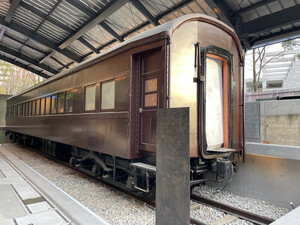
An imperial train is a special train not included in the regular timetable, tailored for special guests such as the Emperor or foreign state guests. Imperial trains consisted of approximately five passenger cars and a locomotive. The car carrying the Emperor was called the Imperial Car, while the cars carrying his entourage were called the Escort Car. Escort Car No. 344 was manufactured in 1932 (Showa 7). It was often attached to the No. 2 Imperial Train during the Showa era. No. 2 was often used as an Imperial Train for Emperor Akihito, who was then Crown Prince. Records show that in April 1959 (Showa 34), this car was used as an Imperial Train prepared to dedicate the Crown Prince's wedding to Ise Shrine.
[Follow Carriage No. 344]
Records indicate that follow carriage No. 330 was equipped with swivel chairs and a facility for cooking simple meals, and No. 344 has the same structure. The interior of the other escort cars featured walnut straight-grain sawn marquetry plywood for the inner paneling, walnut plain-grain plywood for the upper mirror panel, and carpeting on the floor. No. 344 also had an elaborate plywood interior. The car number written in gold lettering in the center of the car body.
[History of Imperial Trains]
Until the Showa era, imperial trains were often arranged for occasions such as weddings and funerals for members of the imperial family, visits to Ise Shrine or Kashihara Shrine to pray for or report on victory in war, and trips to the countryside for events such as the National Athletic Meet and tree-planting ceremonies. However, since the Heisei era, the emperor has often traveled to the countryside on trains used by ordinary people, and imperial trains are now rarely operated.
[Imperial Carriage]
Imperial carriages ridden by His Majesty the Emperor are preserved at the Railway Museum in Saitama City, Saitama Prefecture, and the Meiji Village Museum in Inuyama City, Aichi Prefecture. The oldest of these carriages is Imperial Carriage No. 1, manufactured at the Kobe Works in 1876 (Meiji 9) and used for the opening ceremony of the Kobe-Kyoto railway in 1877 (Meiji 10). It is a two-axle wooden carriage with an arched roof, its side panels painted in a single piece with the Imperial chrysanthemum crest in the center and dragons painted in gold on both sides. Around the eaves are carved chrysanthemum arabesque patterns, and the upper part is painted with a kiriba (leaf leaf) pattern. The room where the Emperor resides, known as the throne room, has walls covered in pale gray silk and vertical mirrors attached to the studs. This carriage embodies the finest arts and crafts of the time, and has been designated an Important Cultural Property.
[Operating the Imperial Train]
The locomotives used to pull the Imperial train were assigned to designated engineers at the Tokyo Locomotive Depot and the Tamachi Electric Railway Depot. On local lines, the best person, both skilled and virtuous, was selected for this honorable task. The most difficult aspects of operating an Imperial train are keeping it running smoothly and on schedule, and stopping correctly. The train runs at speeds comparable to express and limited express trains, but even the slightest shock must be avoided when departing and stopping. Since His Majesty always stands upon arrival and departure to salute those accompanying him, any shocks were absolutely unacceptable, and the train had to depart smoothly so that it would be impossible to tell when it had started moving. Furthermore, the platform at the station where His Majesty disembarks is covered with a red carpet, so the train's entrance and exit had to be perfectly aligned with the entrance and exit of the Imperial carriage.
Specific locomotives are sometimes selected to pull imperial trains, and C51 No. 239 was selected to do so 104 times. This locomotive is preserved at the Kyoto Railway Museum.
Article by Masayuki Fujimoto, curator