FUJI NAGOYA SCIENCE MUSEUM
TOP > Exhibition Guide > Floor Map> Carriage OHA No.2001
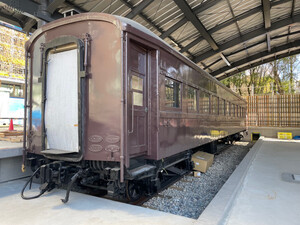
Carriage OHA No.2001


Purpose of Exhibition
In order to nurture children's dreams and further promote science education, a third-class passenger car that was once attached to a passenger train is on display at the Railway Plaza. We hope that visitors will gain a deeper understanding of the railway culture of the past.
Additional Knowledge
[What is Oha35?]
Oha35 is the model name of a passenger car. Electric railcars have a motor under the floor, while diesel railcars have an engine under the floor, providing power for each car. However, passenger cars are not powered and are pulled by steam, electric, or diesel locomotives. The "O" in "Oha" indicates the weight of the car, ranging from 32.5 to 37.5 tons. The "Ha" in "Oha" indicates a third-class car. "I" indicates a first-class car. "Ro" indicates a second-class car. Current trains no longer distinguish between first, second, and third class. JR trains are divided into green cars and regular cars, with third-class cars corresponding to regular cars. The "3" in "35" indicates a steel (hard iron) passenger car (3-9 are steel passenger cars), and the "5" indicates the use of a two-axle bogie (1-7 are two-axle bogie cars).
Production began in 1939 (Showa 14), and as many as 1,301 vehicles were classified as Oha35.
[Carriage OHA35 No. 2001]
This carriage was completed on June 12, 1939, by Nippon Sharyo Manufacturing Co., Ltd., which had a factory in Nagoya, as Suha 33650. In 1941, its number was changed to Oha 35 1, the top number for the Oha 35, and it operated with this number for many years. On November 16, 1966, an electric heater was installed at the JNR Morioka Works, and it was renumbered Oha 35 2001. It was then decommissioned on June 28, 1972, with its final assignment being the Akita Depot. It was subsequently exhibited at Iwate Prefectural Transportation Park in Morioka City, Iwate Prefecture, and stored at the JR East Omiya General Rolling Stock Center. It has been on display at our museum since March 28, 2026.
[The History of Prewar Steel Passenger Cars]
The Ministry of Railways' passenger cars changed from wooden to steel bodies starting with the Oro 41700 series (later the Oro 30 series), manufactured in 1927 (Showa 2). This was implemented due to the severe passenger injuries that would occur if wooden cars were used. However, the Ministry of Railways and rolling stock manufacturers at the time lacked the know-how to manufacture steel car bodies and instead sought the support of shipbuilding companies and other companies for technology and materials. Starting with passenger cars manufactured in 1929 (Showa 4), the car body length increased to 20 meters, and passenger cars manufactured in 1932 (Showa 7) saw the roof shape change from a double roof to a single roof (round roof). The manufacturing method for the underframe also changed from riveting to welding in 1938 (Showa 13). While window widths were mostly 600 mm, 1000 mm became common with the Oha 35, manufactured in 1949 (Showa 14).
[Railway Electrification and Electric Heating]
This Oha 35 2001 was fitted with an electric heating system in 1966 (Showa 41). This was in conjunction with the electrification of the Tohoku Main Line between Sendai and Morioka on October 1, 1965 (Showa 40). Electrification allowed the locomotives pulling passenger cars to switch from steam or diesel to electric, allowing the locomotives to draw electricity from overhead lines and supply it to the passenger cars. This electricity was used to heat the passenger cars. The cold climate of Morioka may also have been a factor in the installation of heating. This section between Sendai and Morioka was electrified with 20,000 volts of AC. Japan's first commercial electric railway, operated in 1895 (Meiji 28), was DC electrified. The first AC electrification on a Japanese railway was the Senzan Line (Miyagi and Yamagata prefectures) in 1954 (Showa 29). Alternating current (AC) can transmit electricity at a higher voltage than direct current (DC), which has the advantage that electricity can be transmitted over longer distances with fewer substations.
Article by Masayuki Fujimoto, curator