FUJI NAGOYA SCIENCE MUSEUM
TOP > Exhibition Guide > Keyword Search > Starting with "E" > Earth > Paleoparadoxia

Paleoparadoxia


Purpose of Exhibition
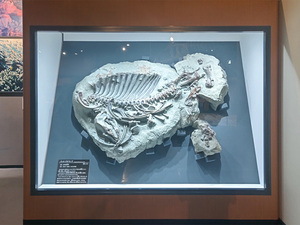
This exhibit aims to showcase the fascinating process of paleontological research - how fossils are discovered, excavated, and studied. By presenting a replica that preserves the original state in which the fossils were embedded in the strata, visitors can gain insight into the world of ancient life and the science of fossils.
Additional Knowledge
[Discovery and Excavation of the Fossil]
On June 5, 2022, a fossil of Paleoparadoxiidae, a member of the extinct marine mammal order Desmostylia, was discovered along the banks of the Toki River in Kamado-cho, Mizunami City, Gifu Prefecture. It was found by a local resident during a community river cleanup. On June 9 and 10, excavation work was carried out using heavy machinery such as excavators, allowing the fossil to be removed along with the surrounding rock.
At the Mizunami Fossil Museum of Miunami city, the fossil underwent careful cleaning. To preserve the position in which the skeleton had been buried in the sediment, a replica of the fossil in its original state - known as a fossil in situ replica - was created for further study and display.
[What the Specimen Reveals]
As research on the specimen progressed, many new insights were uncovered.
For example, the molars preserved in the skull showed significant wear, indicating that the individual was elderly - roughly equivalent to over 60 years old in human terms. Numerous fossilized shark teeth were also found near the skeleton, and some bones have clear bite marks. The excellent preservation of the bones, despite these marks, suggests that the animal was bitten by sharks after death, rather than being killed and eaten.
Additionally, analysis of strontium isotopes in shell fossils found nearby revealed that this Paleoparadoxia lived around 16.5 million years ago. These findings continue to shed light on both the environment of the time and the biology of this enigmatic animal.
By studying the bones, the associated fossils, the mineral concretions attached to the skeleton, and even the way the fossil was preserved in the ground, researchers can gather different kinds of information. Not only actual fossils, but also high-quality replicas, such as this, play a vital role in advancing paleontological research.
Article by KIDA, Risako, curator.