FUJI NAGOYA SCIENCE MUSEUM
TOP > Exhibition Guide > Floor Map> Morrison-type Planetarium
Morrison-type Planetarium

Purpose of Exhibition
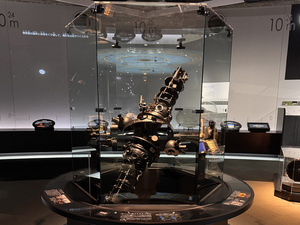
This Morrison-type planetarium is a GOTO INC's S-3 model that was used at the former Arakawa Ward Education Center in Tokyo for 49 years, from April 10, 1964, to March 23, 2013. It served as the oldest domestically produced planetarium in Japan until it was retired due to the aging of the facility and equipment. After retirement, it was displayed at Goto INC and was later relocated to Nagoya City Science Museum in 2025.
In this exhibit, you can take a close look at the structure of the Morrison-type planetarium. Try comparing it with the nearby Zeiss Type IV planetarium to see the differences.
Additional Knowledge
Planetariums that project stars onto a screen using lenses were developed by the German company Carl Zeiss, and in 1926 an improved model capable of projecting the night sky from anywhere in the world was introduced. This type of planetarium is known as the Zeiss type.
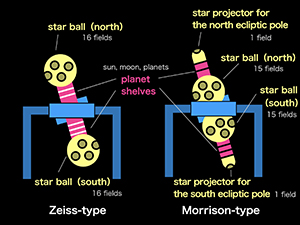
Meanwhile, another type of planetarium was developed in 1952 at the California Academy of Sciences in the United States—this is known as the Morrison type. The two types differ in the arrangement of the star ball, which projects the fixed stars, and the planet shelves, which contain projectors for the Sun, Moon, and planets.
Characteristics of the Zeiss Type
Developed in 1926, the Zeiss-type planetarium was groundbreaking in its ability to mechanically reproduce the starry sky from anywhere in the world, as well as the positions of the Sun, Moon, and planets for any chosen date and time. However, because the heavy components were located at both ends—giving it the nickname “dumbbell type”—a highly rigid structure was required to prevent bending. In addition, the farther the star ball was positioned from the center of the dome, the greater the displacement in the projected star positions became. To reduce this effect, the use of large-diameter domes was recommended.
Characteristics of the Morrison Type
Developed in 1952, the Morrison-type design grouped the star balls at the center, reducing projection displacement and improving weight balance and deflection behavior during rotation and other movements. However, because two planet shelves were separated and could not be mechanically linked, an electrical synchronization system was incorporated. Furthermore, star projectors for the regions near the ecliptic poles (one for the north and one for the south) were installed independently at each end rather than within the central star ball. As a result, each required its own light source, and the magnification of the projected images had to be individually adjusted.
Article by Astronomy Section